
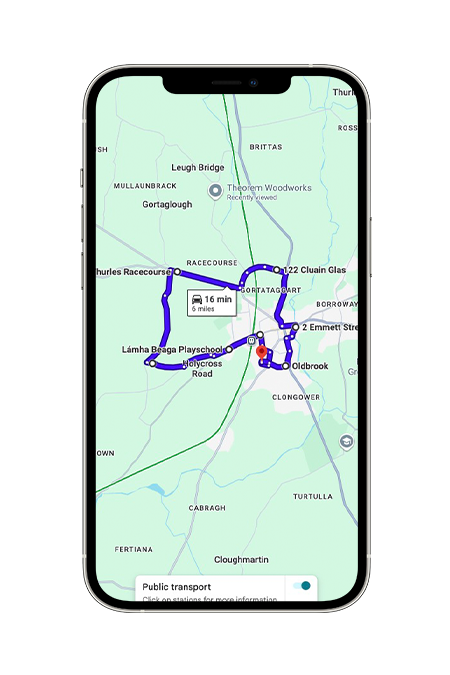
Explore Thurles’s Slievenamon Road, Nenagh Road, Mill Road and busy local roundabouts with realistic Google Maps driving test routes designed around the roads and junctions you’ll encounter on test day.
Practise our Google Maps routes based on Thurles’s local roads and junctions before your driving test.
Instant download · €12.99
Local Tip: Arrive 15-20 minutes early. The area can get busy around school start and finish times.
Pro Tip: Master these hotspots and you’ll eliminate the most common reasons learners fail in Tallaght.
These are the roads, roundabouts and junctions where Tallaght learners most commonly lose marks during the driving test.
The Issue: Emerging from the public service grounds onto the busy Stradavoher link.
Why People Fail: Candidates panic due to steady traffic flows, causing excessive hesitation or pulling out blindly.
The Issue: A high-volume entryway roundabout connecting bypass routes with town traffic.
Why People Fail: Drivers display incorrect lane positioning, drifting across internal markings or choosing the wrong lane.
The Issue: Navigating the highly congested central square featuring multi-lane configurations and tight parking.
Why People Fail: Candidates focus entirely on their exit path and fail to yield to pedestrians at crossings.
The Issue: Narrow housing estate roads heavily used for the reverse around a corner manoeuvre.
Why People Fail: Candidates focus entirely on the tight kerb line and fail to maintain 360-degree observations.
The Issue: A tight town-centre intersection with a sharp incline and restricted visibility.
Why People Fail: Candidates execute a poor hill start (rolling back) or fail to creep forward safely.
The Issue: A solid white stop line at a blind junction near the railway station.
Why People Fail: Performing a rolling stop instead of bringing the wheels to a complete, dead stop behind the line.
The Issue: Narrow regional paths featuring sharp blind corners and oncoming heavy goods vehicles.
Why People Fail: Poor road positioning; candidates hug the centre line too closely or drive too fast.
The Issue: A quiet, tight residential loop heavily used for executing the turnabout (three-point turn).
Why People Fail: Drivers hit or mount concrete kerbs due to poor steering or move off without checking blind spots.
The Issue: Emerging from local links onto the faster, highly trafficked regional gateway.
Why People Fail: Candidates fail to creep forward safely for clear visibility, pulling out directly into cross-traffic.
The Issue: A steep residential sloped road section used to test the hill start check.
Why People Fail: Poor handbrake-clutch coordination causes the vehicle to roll back or stall the engine.
Examiners see the same patterns again and again. Avoid these common mistakes to give yourself the best chance of passing.
Liberty Square: Disorientation or blocking chaotic traffic layouts.
Mirrors & Observation: Skipping deliberate head movement mirror checks.
Stop Signs: Rolling past solid white stop lines
Nenagh Road Approach: Misjudging gaps or forcing oncoming traffic.
Roundabout Progress: Hesitating excessively at clear traffic gaps.
Estate Manoeuvres: Ignoring 360° scans while reversing/turning.
Narrow Streets Clearance: Driving too close to parked cars.
Speed Limit Zone Changes: Adapting to speed limit changes late.
Vehicle Control: Repeated stalling in stop-start traffic.
Moving Off: Missing final shoulder blind-spot checks.
Most Tallaght learners fail due to observation, positioning, and hesitation rather than manoeuvres themselves.
These are the local hazards, misleading road layouts and hidden danger zones that frequently catch Thurles learners off guard during the driving test.
Hazard: Wide, congested square packed with diagonal parking and pedestrians.
Trap: Misreading unmarked road positioning or missing reversing cars.
Hazard: High-volume roundabout handling fast commuter traffic off the M8.
Trap: Undue hesitation on entry or omitting left-mirror checks when exiting.
Hazard: Speed drop from 80 km/h regional buffer to 50 km/h town limits.
Trap: Coasting past limit signs and dropping speed late.
Hazard: Tight historic lanes crowded with buses, delivery vans, and open doors.
Trap: Forcing through narrow gaps instead of yielding to oncoming traffic.
Hazard: Blind town junctions obscured by historic walls and narrow footpaths.
Trap: Emerging too quickly without using 1st gear for “creep and peep.”
Hazard: Narrow bridge underpass with oncoming heavy vehicles hugging the centre.
Trap: Misjudging clearance space or failing to ease off early for wide loads.
Hazard: Sloped estate roads used for reverse manoeuvres.
Trap: Mirror-relying during manoeuvres instead of physical 360° rear checks.
Hazard: Confined street layout dropping into a narrow one-way system.
Trap: Failing to position far-right when preparing for right-hand turns.
Hazard: Compact painted islands where drivers cut corners.
Trap: Driving directly over the painted island when turning right.
Hazard: Tight cul-de-sacs with uneven cambers near Semple Stadium.
Trap: Rolling during gear changes or touching kerbs during turnabouts.
Local awareness, correct observations, and smooth decision-making are key to handling these traps with confidence.
Built from real learner feedback, local route analysis, and examiner behaviour patterns.
Instant PDF download · €12.99
Secure checkout · Access immediately
100% Tallaght focused
Clear maps & instructions
Prepare with confidence
Download and start today
Clear answers to the most common questions about the Thurles test centre and driving test routes.
The routes are moderate in difficulty. You’ll encounter a mix of residential roads, busy main roads, roundabouts, and dual carriageways. Good observation and lane discipline are key to success.
Common roads used in Thurles driving tests include R659, Nenagh Road (N62), Templemore Road (R498), Slievenamon Road, Jimmy Doyle Road (L4027), Liberty Square, Parnell Street, Croke Street, and Racecourse Road. Routes also commonly use residential estates around Kennedy Park, Collins Park and Childers Park.
Yes. Common roundabouts include Kennedy Park Roundabout, the L4027/Jimmy Doyle Road mini-roundabout, and the Jimmy Doyle Road roundabouts. Roundabouts also appear on approach roads around Thurles.
Common issues include poor observation at junctions, incorrect lane choice on roundabouts, speeding on open roads, and hesitation at controlled intersections.
Yes! Our pack includes Google Maps route previews so you can familiarise yourself with the roads, junctions, and roundabouts before your test.
No. RSA Driving Test Centre in Thurles is not particularly busy at present. Late-August 2026 estimates put the waiting time at around 4.4 weeks, well below the national average of about 8.7 weeks.
We use cookies to improve your browsing experience, analyse site traffic, and support essential website functionality. By clicking "Accept All", you consent to our use of cookies.
Manage your cookie preferences below:
Essential cookies enable basic functions and are necessary for the proper function of the website.
These cookies are needed for adding comments on this website.
Stripe is a payment processing platform that enables businesses to accept online payments securely and efficiently.
Service URL: stripe.com (opens in a new window)
Statistics cookies collect information anonymously. This information helps us understand how visitors use our website.
Google Analytics is a powerful tool that tracks and analyzes website traffic for informed marketing decisions.
Service URL: policies.google.com (opens in a new window)
You can find more information in our Cookie Policy and Terms & Conditions.