
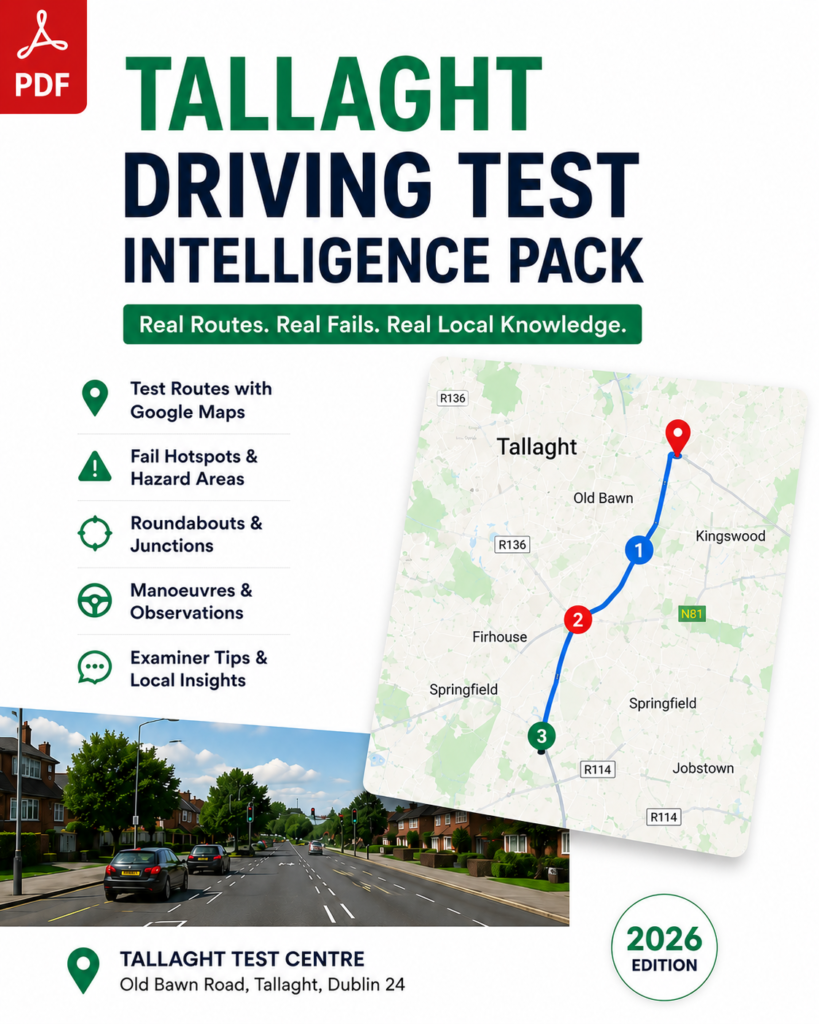
Real test routes. Real fail points. Real local knowledge.
Everything you need to know to pass the Tallaght Driving Test.
From 1,000+ learner reviews
Instant download · €24.99
Local Tip: Arrive 15-20 minutes early. The area can get busy around school start and finish times.
Pro Tip: Master these hotspots and you’ll eliminate the most common reasons learners fail in Tallaght.
These are the roads, roundabouts and junctions where Tallaght learners most commonly lose marks during the driving test.
Why People Fail: Drivers instinctively take the left lane, leading to cutting across markings or dangerous last-minute lane changes.
The Issue: The speed limit transitions rapidly between 50 km/h and 60 km/h.
Why People Fail: Failure to notice speed signs leads to driving too slow (progression fault) or breaking the speed limit.
The Issue: High-volume traffic lights with short amber cycles and tightly timed sequences.
Why People Fail: Drivers hesitate when turning right, block yellow box junctions, or cross stop lines as lights turn red.
The Issue: A narrow residential loop featuring high pedestrian foot traffic and a 50 km/h limit.
Why People Fail: Drivers drive excessively slow (e.g., 30 km/h), prompting a Grade 2 or 3 failure for lack of progression on a 50 km/h road.
The Issue: A highly complex residential maze dense with oversized speed bumps and sharp bends.
Why People Fail: Hitting the speed bumps too quickly without checking mirrors or failing to drop smoothly into 2nd gear.
The Issue: T-junction exits leading from quiet residential clusters onto busier main roads.
Why People Fail: Committing “rolling stops” by slowing down but failing to bring the vehicle to a complete standstill behind the white stop line.
The Issue: Faded or missing road markings on the roundabout entry points and lanes.
Why People Fail: Severe loss of lane discipline and cutting corners due to the lack of clear visual guides.
The Issue: Tight blind corners obscured by mature trees, walls, and parked cars.
Why People Fail: Creeping forward without performing the full mirror-signal-mirror sequence or failing to check blind spots.
The Issue: Fast-moving multi-lane merging zones with significant commercial traffic.
Why People Fail: Ineffective mirror usage and failure to glance over the shoulder when merging into gaps.
The Issue: Areas with variable speeds, sudden pedestrian crossings, and school-hour congestion.
Why People Fail: Inadequate observation of children on pavements and failing to yield right-of-way quickly enough.
Examiners see the same patterns again and again. Avoid these common mistakes to give yourself the best chance of passing.
Speeding mistakes: Missing speed signs or driving too fast for the area.
Too hesitant: Waiting too long at clear gaps in traffic.
Blocking traffic: Not moving over when turning right.
Yellow boxes: Getting stuck inside a yellow box junction.
Wrong lanes: Getting into the incorrect lane at roundabouts.
No mirror checks: Signalling before checking mirrors.
Bad positioning: Driving too close to the kerb or centre line.
Rolling back: Letting the car roll on hill starts.
Rolling stops: Failing to stop completely at Stop signs.
Most Tallaght learners fail due to observation, positioning, and hesitation rather than manoeuvres themselves.
These are the local hazards, misleading road layouts and hidden danger zones that frequently catch Tallaght learners off guard during the driving test.
Hazard: Road layout switches between 50 km/h and 60 km/h.
Trap: Driving too slowly in fast zones or speeding in slow zones.
Hazard: Heavy, fast-moving traffic on right-hand turns.
Trap: Impatiently pulling out or waiting too long at clear gaps.
Hazard: Large, frequent speed bumps in residential estates.
Trap: Hitting ramps too fast or braking without checking mirrors.
Hazard: Hidden T-junctions blocked by walls, hedges, and parked cars.
Trap: Approaching junctions too quickly instead of stopping to creep out safely.
Hazard: Small, busy roundabouts with fast lane transitions.
Trap: Cutting across lanes or failing to check left mirrors when exiting.
Hazard: Sudden drops to 30 km/h speed limits with high pedestrian traffic.
Trap: Missing the 30 km/h sign and maintaining normal road speed.
Hazard: Large diagonal white lines (ghost islands) on wide roads.
Trap: Driving over these markings to position early for a turn.
Hazard: Sloped kerbs and active residential driveways.
Trap: Allowing the car to roll or failing to stop for approaching pedestrians.
Hazard: Minor hidden inclines used to test moving off from a slope.
Trap: Exaggerating head movements instead of following a precise mirror routine.
Local awareness, correct observations, and smooth decision-making are key to handling these traps with confidence.
Built from real learner feedback, local route analysis, and examiner behaviour patterns.
Instant PDF download · €24.99
Secure checkout · Access immediately
100% Tallaght focused
Clear maps & instructions
Prepare with confidence
Download and start today
Clear answers to the most common questions about the Tallaght test centre and driving test routes.
The routes are moderate in difficulty. You’ll encounter a mix of residential roads, busy main roads, roundabouts, and dual carriageways. Good observation and lane discipline are key to success.
Common roads include Broomhill Road, Greenhills Road, Belgard Road, Tymon North Road, Castletymon Road, and the N81. Routes may vary depending on traffic conditions and test time.
Yes. Most tests include at least one multi-lane roundabout, such as the Hospital Roundabout or the Broomhill Roundabout. Being confident with lane positioning is essential.
Common issues include poor observation at junctions, incorrect lane choice on roundabouts, speeding on open roads, and hesitation at controlled intersections.Our route pack highlights all known hotspots.
Yes! Our pack includes Google Maps route previews so you can familiarise yourself with the roads, junctions, and roundabouts before your test.
Tallaght is one of the busiest test centres in Dublin. Tests during weekday mornings and after-school hours tend to have heavier traffic.
We use cookies to improve your browsing experience, analyse site traffic, and support essential website functionality. By clicking "Accept All", you consent to our use of cookies.
Manage your cookie preferences below:
Essential cookies enable basic functions and are necessary for the proper function of the website.
These cookies are needed for adding comments on this website.
Stripe is a payment processing platform that enables businesses to accept online payments securely and efficiently.
Service URL: stripe.com (opens in a new window)
Statistics cookies collect information anonymously. This information helps us understand how visitors use our website.
Google Analytics is a powerful tool that tracks and analyzes website traffic for informed marketing decisions.
Service URL: policies.google.com (opens in a new window)
You can find more information in our Cookie Policy and Terms & Conditions.